Authors: Kristal A.C. Jollie, Brad S. Law, Katarina M. Mikac and John M. Martin
Journal: Australian Zoologist (published August 29, 2025)
DOI: https://doi.org/10.7882/AZ.2025.032
The Kedron Brook Catchment Branch is passionate about protecting and enhancing habitats for our local wildlife. Tree hollows are vital for many native species, providing shelter, breeding sites and protection from predators. However, habitat loss from urban development, logging and climate events, natural hollows are becoming scarce. This article shares insights from a 2025 study published in Australian Zoologist, which explores an innovative solution, chainsaw-carved hollows (CHs). This research offers valuable lessons for conservation efforts in the. Kedron Brook catchment and greater region.
Why Tree Hollows Matter
Over 300 vertebrate species in Australia rely on tree hollows for survival. These include birds such as owls and treecreepers, mammals such as gliders and possums and even bats. Natural hollows take over 100 years to form in mature trees, making them irreplaceable in young or disturbed forests. Traditional alternatives like nest boxes have drawbacks, they often overheat, require frequent maintenance and don’t mimic natural conditions well. Chainsaw-carved hollows, however, are sculpted directly into trees, creating cavities that better replicate natural hollows improved thermal regulation (up to 9°C cooler in summer and 3°C warmer in winter compared to nest boxes).
The Study: Seven Years of Monitoring
The study, led by researchers Kristal Jollie, Brad Law, Katarina Mikac and John Martin, re-assessed 16 chainsaw-carved hollows installed in 2015 in Currambene State Forest, New South Wales, a dry sclerophyll forest a known hollow shortage. The hollows were carved into both live and dead trees at about 4 meters height, entrances tailored for birds, mammals, or bats.
Seven years later, in 2022, the. team evaluated hollows’ condition and wildlife use through physical inspections and infrared camera monitoring. Key findings include:
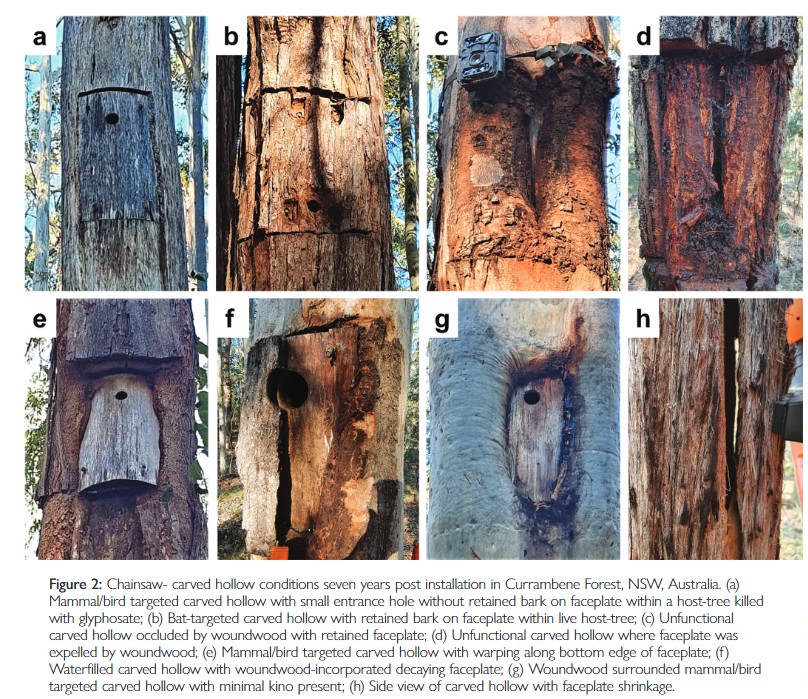
- Durability and Maintenance: No trees failed due to carving, but 19% (three host trees) were lost to external factors such as being uprooted and likely illegal felling. Of remaining, 69% (13 host trees) were still functional. Issues like faceplate shrinkage (average 10 mm) and moisture buildup were noted, but overall, CHs showed good longevity. About 2 host trees needed immediate fixes, projections that five might require maintenance by year 10. Live trees developed woundwood to secure faceplates, while dead trees extended maintenance intervals.
- Wildlife Usage: Nine vertebrate species interacted hollows, four occupying them: the. feathertail glider (Acrobates pygmaeus), brown antechinus (Antechinus stuartii), sugar glider (Petaurus breviceps) and white-throated treecreeper (Cormobates leucophaea). Occupations favored hollows minimal shrinkage and low moisture. Interestingly, one water-filled hollow acted as a “water station,” attracting most species diversity—including frequent visits from feathertail gliders.
Implications for Kedron Brook Conservation
While the. study was conducted in NSW, its principles are highly relevant to our subtropical forests in Queensland. The Kedron Brook catchment faces similar challenges hollow shortages due to past clearing and invasive species. Chainsaw-carved hollows could be a practical tool for our restoration projects, especially in areas like our bushcare sites where mature trees are limited.
Recommendations from study align our work:
- Prioritise preserving natural hollows.
- Use diverse designs (e.g. varied entrance sizes and drainage) in both live and dead trees.
- Monitor for moisture and select tree species carefully to minimise maintenance.
- Explore tools like HollowHog drill for less invasive carving.
By adopting such innovations, we can boost biodiversity and support hollow-dependent species in our local natural areas.
Get Involved
Interested in habitat restoration? Become involved in one of the. many Bushcare Groups that operates in Kedron Brook catchment.
For more details on study check out full article Jollie, K. A. C., Law, B. S., Mikac, K. M., & Martin, J. M. (2025). Re-assessment of chainsaw-carved hollows and animal use seven years after installation. Australian Zoologist. Advance online publication. https://doi.org/10.7882/AZ.2025.032